The latest Pixar movie, Cars 2, was released on DVD on Tuesday. Some of you may have seen my essay regarding that franchise that was posted on Design Observer the week of Cars 2’s release in theaters. It stirred up quite a bit of controversy, and I was largely berated in the comments by people who didn’t get the joke, or didn’t like it, or both. And, in probably the oddest bit of fallout, the film critic and writer Roger Ebert, basically ripped off my idea and repurposed it for a piece about the Transformers. Needless to say, it was all interesting and (mostly) fun to watch that unfold. If you didn’t see it before, here it is, republished on my home turf for your enjoyment.
--------------------------------------------------------------
Like
many people, especially creative types, I’m a big fan of Pixar movies. Their
story telling, artful animation, and great voice acting are unrivaled in the
realm of animation production. However, they do sometimes take missteps,
especially in their design choices. Take for example A Bug’s Life, where the ant characters only
have 4 limbs, or the bizarre conceit in Ratatouille that a rat can control a human’s
actions by yanking on his hair. It’s perhaps easy to overlook such small
things, but in otherwise well thought out environments and scenarios, they are
poorly conceived and glaringly so.
Without
question, their greatest misstep in design, and perhaps in general, is the film
Cars. Released
in 2006, this film follows the “stranger comes to town” adventures of stock car
racing sensation Lightning McQueen. While it was less than loved by critics,
there is no question it was a commercial success. In fact, some would say it is
Pixar’s most obvious grab at a pay day, appealing to the NASCAR set without
even the thinnest of veils. But I would argue its middle-American appeal
goes much deeper than its subject matter. Indeed, I believe Cars is a vehicle for the
conservative, science-denying belief known as Intelligent Design.
Rooted
in the Creationist philosophy, Intelligent Design
attempts to explain complex scientific phenomenon, especially biological
systems such as photosynthesis, or the structure of the human eye, as being the
work of a Designer, commonly understood to be the Christian God. In essence,
anything that science has failed to yet explain is easily attributable to the
work of a higher being whose intelligence, and rationale can never be
understood via human empirical thinking.
Cars, more than any other Pixar world,
is designed and built with that very premise as its foundation. It is a world
populated entirely by cars, trucks, aircraft, and RVs. These vehicles are
essentially stand-ins for human beings. Their only companions in the animal
kingdom seem to be tractors (which are cows), combines (bulls), and little VW
Beetles as winged house flies. Other than a pair of steer horns mounted to the
front of a Cadillac, and the dinosaur logo of Dinoco Oil, there is no sign of
any animal we would recognize... Not a bird in the sky, nor a squirrel in a
tree. So one is left to surmise that sentient vehicles simply exist, and always
have, independent of any other circle of life.
The design
of the vehicles is devoid of any suggestion of natural selection. The cars have
eyes in their windshield, and mouths, complete with teeth and tongues, between
their headlights. (Apparently motorcycles don’t exist, presumably because the
Designer couldn’t figure out how to give them a face.) They can flex and move
their metal frames, undercarriages, and tires at will, and yet they’re
undoubtedly made of metal, plastic and rubber. They are imbued with life,
which apparently allows them to ignore the laws of physics. Conveniently,
non-living fixtures made of those same materials (buildings, furniture, etc.),
obey those laws. Indeed, it is those very fixtures that offer the most
disturbing glimpse into the Designer’s machinations. It’s as if the world was
made by humans, now long gone, and replaced by living, breathing autos. One
might expect Charlton Heston to crash land on the planet and later discover
that those maniacs
blew it up.
On this Planet
of the Cars,
buildings not much different than ours awkwardly accommodate their four-wheeled
tenants; gas pumps—again, like ours—operate with precision simply by pressing a
button the ground; and farms, growing vegetables for goodness know who, line
the highways. Even the cars themselves are at the whim of a seemingly human
mind. They have doors and windows that never open. They’re alive and moving,
but can only drive with gas in their tanks. Boy cars and girl cars are
attracted to each other, raising awkward questions about reproduction (and yet,
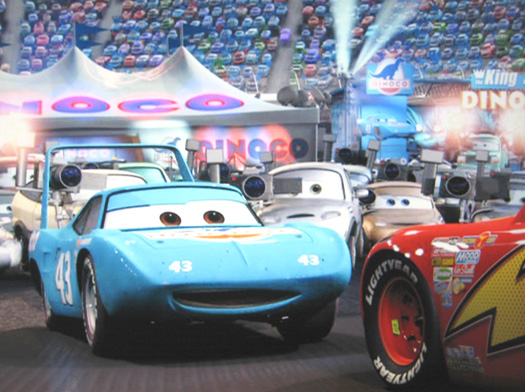
no kid cars?). Photojournalist cars are forced to use large, clumsy,
tired-mounted rigs to hold cameras, and the racing pit crew chiefs wear
comically huge earphones on their non-ears. Perhaps the greatest injustice seen
is a minivan toting a mattress atop its roof down the interstate. Do I need to
mention they don’t sleep in beds?
But there
are a couple of crucial elements in the design of this world that point not to
a human overlord, but an all-powerful Designer with a bad case of motorhead.
The rock formations surrounding the movie’s main location, the town of Radiator
Springs, resemble similar landmarks of our American Southwest, particularly Monument Valley, with one major
difference: They are in the shapes of cars and car parts. That would be as if
our Mount Rushmore was a naturally occurring phenomenon. But even more
inexplicable than the Geo-logy:
if one looks closely enough, cloud formations resembling tire tracks can be
seen drifting through the sky. Certainly, it’s no mistake that this most
befuddling design element is also the most heavenward. There’s something up
there, and It won’t be explained. But It does have a name, and we can thank the
tractor trailer character Mack for this revelation. Upon finding his lost
friend McQueen late in the second act, he exclaims, “Thank the Manufacturer!” Must
we?
This
weekend Cars 2
opens. It will be the first Pixar movie I make a point of not seeing. It’s not
that I even mind so much that it’s propaganda, or even that it’s propaganda for
“The Manufacturer.” In theory, I could forgive that. What I can’t forgive is
that director John Lasseter and his team hung their hat on Intelligent Design,
and alas, it’s anything but.




 Posts
Posts


